
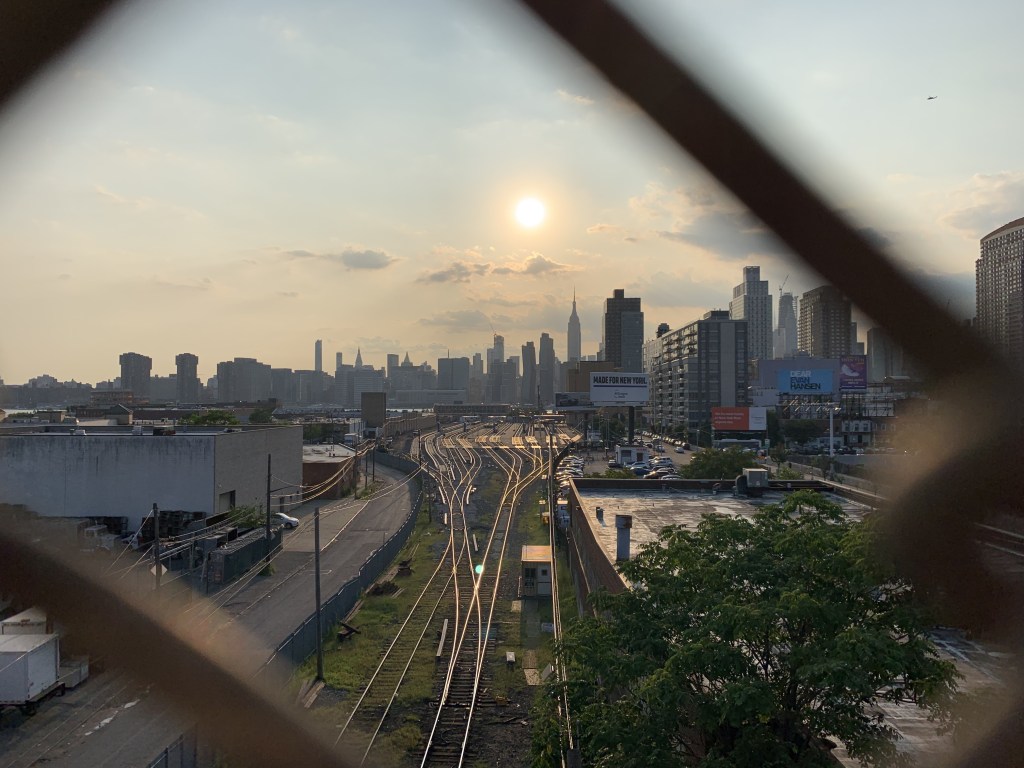
Function – I was selected by University of Pittsburgh as a scholar-in-residence to conduct an independent research project evaluating sustainable transportation, urban design, and infrastructure solutions across New York City .
Mission – I sought to learn more about public transit in the United States’ transit hub, New York City.
I utilized multiple research methods to gather insights, and assembled a report to share those findings.
Background – During my Architecture and Urban Design studies in Pittsburgh, I read a book Streetfight: Handbook for an Urban Revolution by Janette Sadik-Khan. This helped further my understanding of the role that movement plays in the solutions we create in the built environment. However, a question I was left with was what happens to our well-intentioned solutions or planning when times of crisis, specifically natural disasters, occur?
Janette Sadik-Khan’s work focused primarily in New York City. New York City had also been faced with Hurricane Sandy in recent memory. So I took my curiosity and further questions with me for a summer of fellowship research.
Additionally, my hope was that with some of my findings for what worked in New York City, I could begin to synthesize and imagine how they could be scaled appropriately for smaller-markets, like that of Pittsburgh where I was in school.
Research – I executed a multi-method research strategy. I utilized historical archival documents at the New York Public Library and New York Transit Museum to get a foundational understanding of the history of public transit in the city. I was an active participant in community transit meetings, where I got an understanding of the present-day transit concerns of residents. I had direct consultations with MTA officials including the Chief Environmental Engineer Tom Abdallah, who recalled what it was like managing a natural disaster like Hurricane Sandy as part of a major transportation organization.
These different research methods helped me get an understanding of all the different modes of transportation that are available, particularly in a large metro area like New York City. They also helped me focus on some of the qualitative and user experience aspects of both being a rider in the broader New York City transportation system, and managing a transportation system that comes with it’s own history and current challenges.
Lessons Learned – I mapped some of my experiences and learnings in an interactive map.
My main takeaways from that summer of research include
- New York City being the “city that never sleeps” helps its transit resilience, both for riders and planners/operators. Since the city never turns off, planners and operations teams are forced to frequently use their strategic backup plans for operations like construction. However, this frequency also translates to a level of literacy for your average rider in New York City. This means that in a natural disaster like Hurricane Sandy, when flooding closes all the subways, then planners, operations teams, and even many riders are already well-versed in deploying and using backup bus routes.
- Not all public transit modes are created equal – especially from a cost perspective. From a planning and operations perspective, something like additional subway stops are very expensive – see the world’s most expensive subway construction along 2nd Ave which is home to part of the MTA’s Q line. From a rider perspective, while modes like Long Island Rail Road or Metro North Rail Road offer the comfort of trains, they are not nearly as affordable as the subway. From community meetings I found that some riders who lived closest to LIRR or Metro North stations opted for far less efficient trips, or even opted to just drive more regularly, simply because the lack of affordability of the LIRR/Metro North.
- Buses solve multiple frequent problems. For both planners/operators and riders, buses are increasingly viewed as a favorable solution. For planners and operators buses/bus routes are much easier to implement than rail-based modes, both from an initial construction, and longer-term maintenance perspective. Buses are also much more adaptable in situations that require planning or operational flexibility. From a rider’s perspective, as long as the bus was reasonably clean, comfortable, and moving efficiently it was viewed as a fine alternative to the subway. This was especially the case for those LIRR/Metro North riders, as the cost was more similar to that of a subway fare that than more expensive LIRR/Metro North fare. With Select Bus Service routes gaining traction in the city, I’m even more curious about the future of buses in the city.
- Update: One of the campaign initiatives of new New York City Mayor Mamdani was free city buses. It’s unclear on the specific details, but I’ll be curious if this gets implemented
During that summer in New York City I tried to take as many modes of transit across the city and broader region as I could – for research and in the spirit of furthering my curiosity on public transit and systems thinking. One could spend multiple lifetimes analyzing the transportation systems that make up the broader region, so I was happy to spend part of mine learning what keeps a global city going.
 Zac Sewall